

BrandUte vs ServiceM8: Booking Front Door or Complete Job Management System?
ServiceM8 is a broad job-management platform covering scheduling, job cards, quoting, invoicing, payments, customer communication and field operations. BrandUte is a managed public Front Door designed to turn a business domain and existing customer traffic into qualified enquiries and clear next steps.
BrandUte publishes this comparison and has a commercial interest in the subject. We have aimed to describe ServiceM8 accurately using its official public information and to identify situations where ServiceM8 is clearly the stronger option. Features, pricing, payment rates and plan limits can change, so confirm important purchasing information directly with each provider.
These products overlap, but their primary purposes are different.
When you need to run jobs, staff and field operations
- You need staff scheduling and dispatch.
- You want job cards and complete customer histories.
- You need quotes, invoices and payment collection.
- You want accounting integrations and reporting.
- You need field staff to access job information from an app.
- You want online booking connected directly to your schedule.
When you need a managed customer-facing acquisition journey
- You want to start with a memorable business domain.
- You want professional domain-based email.
- You need several customer pathways, not only instant booking.
- You want enquiries qualified before the business follows up.
- You prefer BrandUte to configure and test the public journey.
- You are not ready to migrate your complete operations platform.
When you want a managed Front Door and a mature job system
- BrandUte becomes the public marketing destination.
- Customers are guided to the right service or pathway.
- Standard bookings can continue to ServiceM8.
- ServiceM8 manages scheduling, staff and job delivery.
- Automated syncing would require a separate integration.
BrandUte and ServiceM8 are more closely related than BrandUte and a marketplace such as hipages.
Both can sit inside the direct customer journey of an individual trade or service business. Both can support bookings, quotes, payments and customer communication.
However, ServiceM8 is primarily designed to run the operational side of a service business after a lead or job enters the system. BrandUte is primarily designed to create and manage the public Front Door through which the customer arrives.
This means the most useful question is not simply:
“Which one is better?” The useful question is: “Where should the customer journey begin, and which system should manage the work after it becomes a job?”
What is ServiceM8?
ServiceM8 is a job-management platform designed for trade and service businesses.
Its core purpose is to keep jobs, customers, staff, schedules, communication and financial administration together throughout the service-delivery process.
ServiceM8’s current essential features include:
- job cards;
- staff scheduling;
- quotes and invoices;
- full customer and job history;
- online bookings;
- card payments;
- automated customer communication;
- accounting integrations;
- reporting;
- staff-location and dispatch tools;
- recurring work;
- forms and certificates;
- job costing and profitability tools on relevant plans; and
- optional phone and additional operational functions.
Its online booking system can also allow customers to choose a service, answer service-specific questions, receive a calculated price, select an available time, make a deposit or payment and create a scheduled job.
ServiceM8 is therefore not merely an internal calendar or invoicing app. It can participate in both the public customer journey and the complete delivery of the work.
Official source: ServiceM8 overviewWhat is the BrandUte Front Door?
BrandUte builds the public customer-acquisition and conversion journey for an individual service business.
The Front Door Package can include:
- a selected Australian business domain;
- professional domain-based email;
- a branded mobile-first customer page;
- business services and service-area information;
- structured job and enquiry questions;
- qualification and availability rules;
- booking, quote and callback pathways;
- deposit or payment pathways where enabled;
- review-request journeys;
- a business portal;
- hosting and technical management; and
- guided onboarding, testing and launch.
BrandUte is intended to be the destination used across Google, an existing website, referrals, social media, vehicles, signs, invoices, email signatures, links and QR codes.
It is particularly useful when the business does not want every customer to move immediately into a fixed-price online booking.
Depending on the job, the customer might instead:
- submit a qualified quote request;
- request a callback;
- upload supporting information or photographs;
- request an arrival window;
- continue to an external booking system;
- accept a quote and make a deposit; or
- leave a review after the work is completed.
BrandUte is not currently positioned as a complete replacement for a mature field-service management system.
The products are strongest at different layers.
BrandUte’s strongest position
- Memorable business domain
- Professional business email
- Customer-facing business page
- Marketing links and QR destinations
- Qualification before the next step
- Several possible customer pathways
- Managed public setup and launch
Where the products overlap
- Customer questions
- Online booking
- Quote presentation and acceptance
- Deposits and payments
- Booking confirmations
- Customer communication
- Review and feedback requests
ServiceM8’s strongest position
- Job cards and customer history
- Staff scheduling and allocation
- Dispatch and staff locations
- Field-service mobile application
- Quoting and invoicing
- Accounting integrations
- Operational reporting and automation
BrandUte starts with how customers enter. ServiceM8 continues through how the business delivers the work.
BrandUte is primarily a managed acquisition and conversion Front Door. ServiceM8 is primarily the operational system of record for customers, jobs, staff, schedules, invoices and payments.
| Area | ServiceM8 | BrandUte |
|---|---|---|
| Primary role | End-to-end job management and field-service operations | Branded public customer acquisition and conversion journey |
| Customer traffic | Does not provide a marketplace audience; businesses link customers to their ServiceM8 booking experience | Does not guarantee traffic; gives existing traffic a managed branded destination |
| Business domain | Website and email options are available, with additional fees applying | The selected business domain and professional email are central parts of the package |
| Public customer page | Provides an online booking link or form that can be connected to a website | Provides the broader public business Front Door around multiple customer pathways |
| Online booking | Advanced online booking with service questions, live pricing, schedule availability and automatic job creation | Booking requests and pathways configured around the business, including links to external systems where required |
| Complex quote requests | Can create quotes and proposals after a job or enquiry enters the system | Can focus the public intake on collecting the information needed before the business prepares the quote |
| Scheduling and dispatch | Strong staff schedules, allocation windows, dispatch maps, booking suggestions and notifications | Lightweight booking and arrival-window workflows rather than a full field-service dispatch platform |
| Job cards and client history | Core platform capability | Business portal records relevant Front Door activity, but is not positioned as a complete field-service record |
| Quotes and invoices | Broad quote, proposal, invoice, statement and payment functions | Branded quote, acceptance and deposit pathways relevant to the configured customer journey |
| Accounting integration | Available within the ServiceM8 platform | Not currently positioned as a full accounting integration system |
| Staff and field operations | Designed for sole traders and multi-person field teams | Primarily focused on the customer-facing and conversion layer |
| Setup approach | Businesses can self-configure or hire a ServiceM8 Partner | Guided onboarding and managed configuration are central to the BrandUte package |
| Direct technical integration | BrandUte does not currently claim a native automated ServiceM8 integration. A link-based booking handoff can be used, while automated data syncing would require additional integration work. | |
ServiceM8 already covers several functions that BrandUte also discusses.
A credible comparison should not suggest that BrandUte invented online booking, customer questions, quote acceptance or payment collection. ServiceM8 has substantial capability in each of those areas.
Online booking
ServiceM8 can let customers select a service, answer questions, receive a price, choose a time and book into the business schedule.
Quotes and acceptance
ServiceM8 supports online quote acceptance, customer questions, proposal options and professional quote presentation.
Deposits and payments
Customers can make deposits, progress payments and online card payments through ServiceM8’s supported payment functions.
Customer communication
ServiceM8 can send booking confirmations, follow up quotes, chase payments and request customer feedback automatically.
BrandUte’s case is not that ServiceM8 lacks these functions. The case is that some businesses want a broader, managed public Front Door before the customer enters their operational system.
ServiceM8 is stronger when the service can be priced and scheduled automatically.
ServiceM8’s online booking system is designed for services that can be sufficiently standardised.
The business can configure:
- the services available online;
- questions relating to each service;
- conditional questions based on earlier answers;
- pricing rules;
- staff who can perform each service;
- available booking times;
- travel and scheduling considerations;
- discounts for operationally efficient time slots;
- deposit or full prepayment requirements; and
- automatic confirmation and job creation.
This makes ServiceM8 a compelling option for services such as routine cleaning, inspections, maintenance visits, standard pest-control work, fixed-price repairs and other repeatable jobs.
Where BrandUte may be more suitable
Not every service should immediately generate a price and confirmed schedule entry.
Some jobs first require:
- photographs or supporting documents;
- a description of property or site conditions;
- manual review of scope;
- confirmation that specialist equipment is available;
- a decision about whether an inspection is required;
- a callback from the business;
- a custom quote; or
- qualification before booking access is provided.
BrandUte can make that pre-booking journey the centre of the public customer experience. Suitable standard jobs could still continue to a ServiceM8 online booking link.
Official source: ServiceM8 Online BookingCurrent Australian plans are based primarily on monthly job volume.
On the ServiceM8 Australian pricing page checked on 23 July 2026, the following standard monthly prices were listed in Australian dollars including GST.
| Plan | Monthly price | Users | New jobs per month | Included SMS per month | Card payment rate |
|---|---|---|---|---|---|
| Free | $0 | 1 user | 30 | 0 included | 2.10% + 30c |
| Starter | $29 | Unlimited | 50 | 100 | 1.85% + 30c |
| Growing | $79 | Unlimited | 150 | 300 | 1.65% + 30c |
| Premium | $149 | Unlimited | 500 | 1,000 | 1.49% + 30c |
| Premium Plus | $349 | Unlimited | 1,500+ | 3,000 | 1.49% + 30c |
ServiceM8 states that paid plans do not charge per user, plans can be upgraded or downgraded and there are no long-term plan lock-ins.
The free trial currently provides 14 days of access without requiring payment details. The permanent Free plan is designed for a solo operator managing up to 30 new jobs per month.
Some advanced functions and add-ons require particular plans or additional fees. ServiceM8’s website and email offering is also listed as available with fees applying.
BrandUte pricing model
BrandUte is not priced around monthly job cards, staff users or field operations.
The BrandUte package relates to establishing and operating the public Front Door, including the selected domain, professional email, public page, qualification flow, configured customer pathways, hosting and guided launch.
ServiceM8 pricing pays for an operational platform. BrandUte pricing pays for a managed public acquisition and conversion setup. A business needing both should compare the combined business outcome rather than treating the subscriptions as identical products.
Match the platform to the operating problem.
ServiceM8 may suit a business that:
- needs a central job-management platform;
- has multiple staff or field technicians;
- needs scheduling, allocation and dispatch;
- wants quotes, invoices and payments in one system;
- needs customer and job history available in the field;
- wants accounting integrations;
- performs recurring or standardised services;
- wants online bookings to create scheduled jobs automatically; and
- is comfortable configuring the platform or hiring a partner.
BrandUte may suit a business that:
- wants to begin with a memorable business domain;
- wants professional domain-based email;
- needs a focused public customer destination;
- wants several enquiry pathways;
- needs to qualify jobs before offering booking access;
- wants its existing website or systems to remain in place;
- does not yet need deep field-service management;
- prefers a managed public setup; and
- wants the same address used across Google, vehicles and QR codes.
Both may suit a business that:
- wants BrandUte as the public marketing Front Door;
- wants ServiceM8 as the internal operational system;
- has standard jobs suitable for instant online booking;
- also receives complex jobs requiring qualification;
- wants ServiceM8 to manage staff and schedules;
- wants a domain and acquisition experience managed separately;
- accepts a link-based handoff initially; and
- may later invest in automated integration.
BrandUte can become the public layer in front of ServiceM8.
ServiceM8 provides a unique online booking link and code that can be added to a website. That makes a practical link-based handoff possible without claiming that a native automated integration already exists.
The customer discovers the business
They arrive through Google, referrals, an existing website, social media, vehicle signage or a QR code.
BrandUte presents the public Front Door
The customer sees the business, services, service areas and appropriate next actions under the business’s domain.
The customer is guided according to the job
Complex work can continue through a qualified quote request, while standard work can be directed towards online booking.
Suitable customers enter ServiceM8
A customer can follow the business’s ServiceM8 online booking link, select an available time and create the scheduled job.
ServiceM8 manages job delivery
Staff scheduling, job cards, communication, quotes, invoices, payments and operational history remain in ServiceM8.
BrandUte remains the memorable public destination
The same domain can continue to be used across marketing, signage, referrals, QR codes and customer follow-up.
A link-based handoff is different from an automated integration. Automatically creating or updating ServiceM8 jobs from BrandUte data would require separate API or integration development.
Which option is the more logical starting point?
| Business situation | Likely starting point |
|---|---|
| I need to schedule several technicians and track their jobs | ServiceM8 |
| I need quotes, invoices, payments and accounting integration | ServiceM8 |
| I want a professional domain, email and managed customer page | BrandUte |
| My services are fixed-price and can be booked automatically | ServiceM8 Online Booking may be sufficient |
| Most jobs need photos and manual review before quoting | BrandUte may provide a better public intake layer |
| I already use ServiceM8 but my current website converts poorly | BrandUte in front of ServiceM8 |
| I already have a good website and ServiceM8 booking works well | BrandUte may not be necessary |
| I am a solo operator with fewer than 30 jobs per month | Consider ServiceM8 Free for operations; add BrandUte only if the public acquisition problem remains |
| I want one memorable address on my ute and Google profile | BrandUte |
| I want a complete public journey and mature field operations | Consider using BrandUte and ServiceM8 together |
Ten questions to clarify what your business actually needs.
Do I primarily need more customer conversion or better job operations?
How many staff members need schedules and job access?
Can my services be priced and scheduled automatically?
Which jobs require manual review before booking?
Do I need accounting integration and operational reporting?
Is my current public website or landing page converting effectively?
Do I need one destination for Google, vehicles, referrals and QR codes?
Am I prepared to configure a complete operations platform?
Would a simple link between the public page and booking system be enough?
Would I gain enough value from using both systems to justify the setup?
Explore the customer-facing product behind this comparison.
PaintCrew is a working BrandUte demonstration showing how a customer can enter through the business domain, submit a booking request and continue into quotes and payments.
The public customer Front Door
Customers see the business, choose a service, explain the job and enter the appropriate qualification or booking pathway.
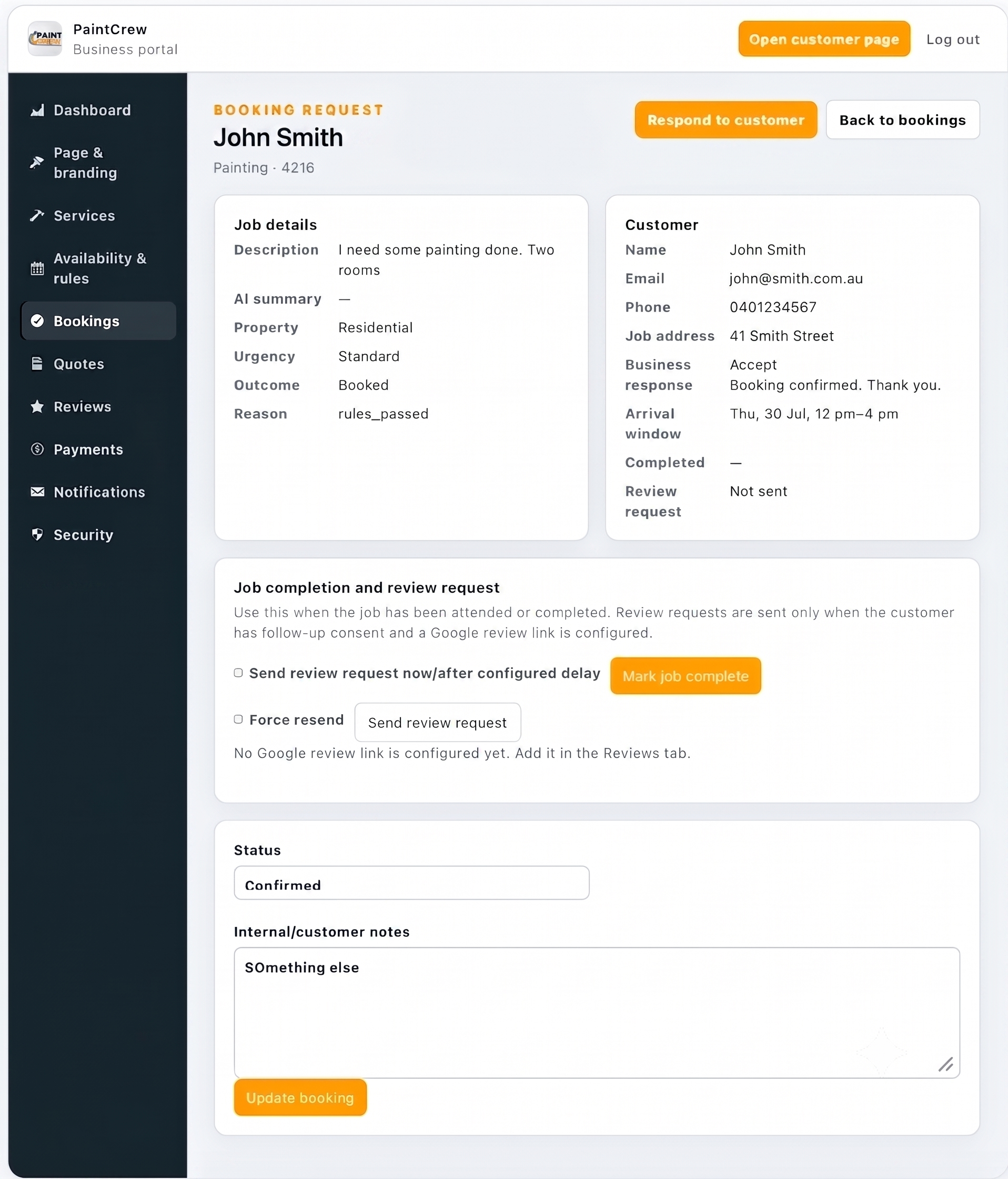
Qualified booking request
Customer details, job information, qualification and business responses remain together.
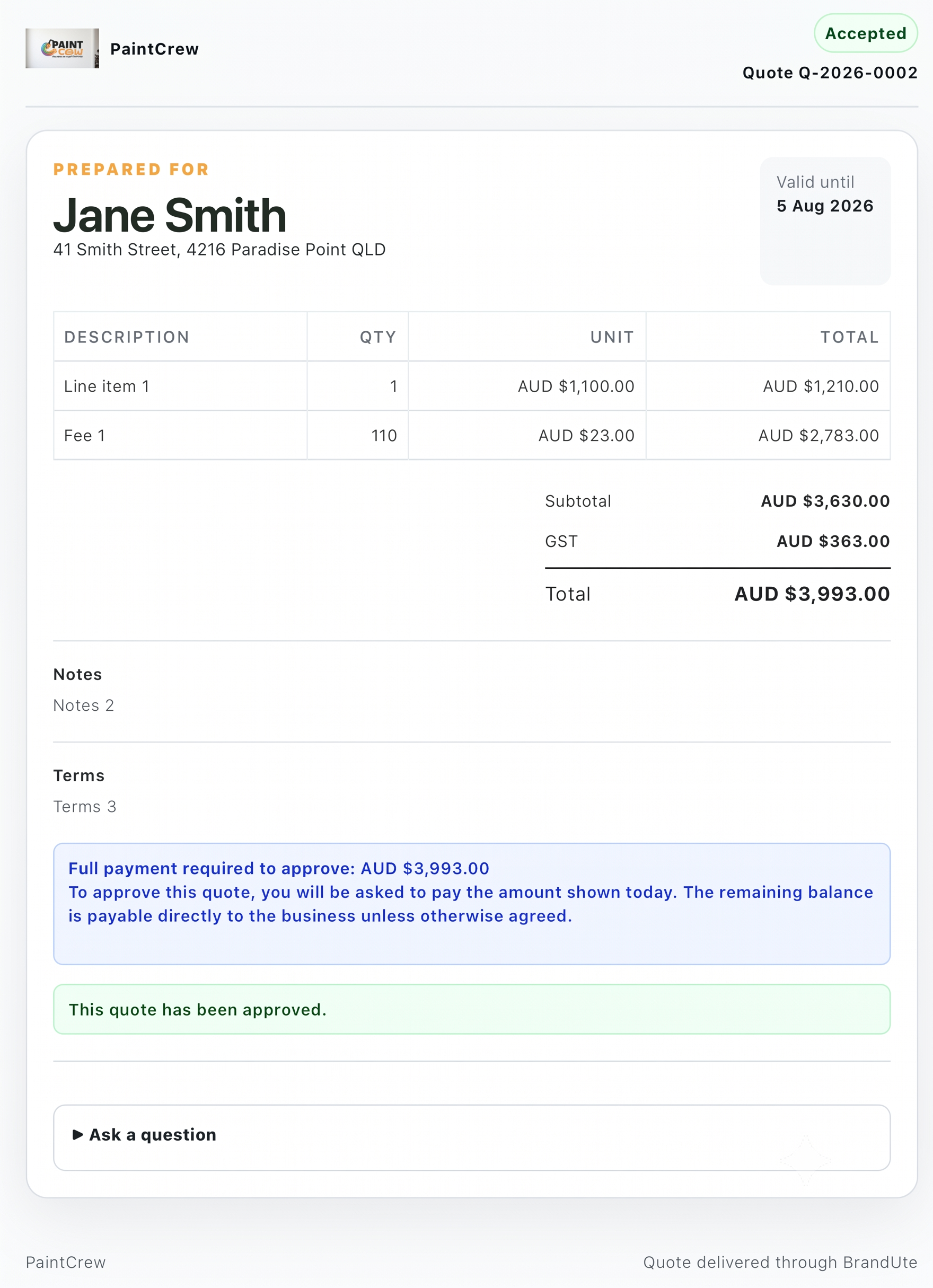
Quote, approval and payment
Suitable enquiries can continue into a branded quote, customer approval and deposit or payment step.
Try the BrandUte customer journey.
Open PaintCrew inside this article or visit the demonstration in a separate browser tab.
PaintCrew is a BrandUte demonstration using sample customer and transaction information.
BrandUte vs ServiceM8 questions
Does BrandUte replace ServiceM8?
Not generally. ServiceM8 is a much broader job-management and field-service platform. BrandUte focuses primarily on the branded public customer journey, qualification and the path towards a booking, quote, payment or review.
Does ServiceM8 already provide online bookings?
Yes. ServiceM8 can provide service selection, conditional questions, live pricing, available booking times, deposits or prepayments and automatic job creation. For standardised services, its online booking capability may be all the business requires.
Why would a ServiceM8 user also consider BrandUte?
A business may want BrandUte to provide the memorable public domain, professional email, broader service presentation and pre-booking qualification journey before suitable customers continue into ServiceM8.
Is there currently a native BrandUte and ServiceM8 integration?
No native automated integration is claimed in this comparison. A BrandUte page can direct suitable customers to a ServiceM8 online booking link. Automatically syncing customer and job data would require additional integration development.
Can ServiceM8 be used for free?
ServiceM8 currently offers a permanent Free plan for one user and up to 30 new jobs per month. It also offers a 14-day trial of the broader platform without requiring payment details.
Does ServiceM8 charge per staff member?
The Free plan is limited to one user. ServiceM8’s current paid plans are listed with unlimited users and are primarily differentiated by monthly job volume, SMS allowances and access to certain add-ons.
Which option is better for a solo tradie?
It depends on the problem. A solo tradie needing scheduling, invoicing and job records may benefit from ServiceM8, including its Free plan. A solo tradie needing a managed public domain and better qualification of direct enquiries may benefit from BrandUte. Some may benefit from both.
Which option is better for a business with several technicians?
ServiceM8 is substantially stronger for multi-technician scheduling, dispatch, job cards, staff notifications, field access and operational reporting. BrandUte could still serve as the public acquisition layer in front of that system.
Can BrandUte work alongside an existing website?
Yes. BrandUte can operate as a focused customer Front Door alongside an existing website. It can be used for Google links, campaigns, signage, QR codes or selected website calls to action.
ServiceM8 is the stronger operations platform. BrandUte is the more focused managed public Front Door.
Choose ServiceM8 when the main need is managing jobs, staff, schedules, quotes, invoices, payments, customer history and field operations.
Choose BrandUte when the main need is creating a memorable business domain and a managed public journey that qualifies customers and sends them towards the right next step.
Consider both when BrandUte should manage the public acquisition experience and ServiceM8 should manage the operational delivery of confirmed jobs.
A business already using ServiceM8 with an effective website and strong online booking journey may not need BrandUte. A business using ServiceM8 but still losing direct enquiries before they enter the system may find the combination valuable.
The best architecture may not be BrandUte instead of ServiceM8. It may be BrandUte before ServiceM8.
Official information used in this comparison
This comparison was reviewed on 23 July 2026. ServiceM8 features, prices, plan limits, payment fees and add-ons can change. Confirm important purchasing details directly with ServiceM8.