
Shared Tradie Leads vs Owned Enquiries: Which Builds a Better Business?
Shared lead platforms can place your business in front of customers actively looking for help. Owned enquiries arrive through your own Google presence, reputation, referrals, advertising, domain and customer journey. Both can produce work, but they create very different costs, pressures and long-term business assets.
BrandUte sells a managed customer Front Door designed to support direct enquiries under the business’s own brand. This guide does not claim that shared lead platforms are universally poor or that owned enquiries are free. A marketplace may be the faster and more practical option when a business lacks sufficient customer demand of its own.
Shared leads can fill the pipeline. Owned enquiries can strengthen the business.
When you need access to active customer demand
- The business is new or has limited visibility.
- You have gaps in the job pipeline.
- You can respond quickly to new opportunities.
- You have enough capacity to quote additional jobs.
- Your margins can support the acquisition cost.
When the business already earns attention and referrals
- Customers already find you through Google or word of mouth.
- You want enquiries arriving through your own business identity.
- You want to collect better job information.
- You want more control over the customer journey.
- You are building a channel that can compound over time.
When short-term volume and long-term ownership both matter
- Use marketplace opportunities to support current capacity.
- Use your own domain for direct customers and referrals.
- Measure each channel separately.
- Keep channels that produce profitable jobs.
- Reduce dependence gradually rather than emotionally.
Most trade and service businesses need a continuing supply of new work. The disagreement is usually about where those opportunities should come from.
One approach is to use a platform that already attracts customers and distributes job opportunities to relevant businesses.
Another is to build direct demand through:
- Google Business Profile;
- search visibility;
- customer reviews;
- referrals;
- repeat customers;
- paid advertising;
- social media;
- vehicle and job-site signage;
- a memorable business domain; and
- a customer journey controlled by the individual business.
The first approach can create opportunities quickly. The second can create a business asset, but usually requires more time, consistency and investment.
A shared lead is access to an opportunity. An owned enquiry is the result of attention directed to your individual business.
What do shared leads and owned enquiries mean?
An opportunity supplied through another platform
The customer begins inside a marketplace or lead-generation service. The platform matches or distributes the request to one or more relevant businesses.
- The platform attracts the customer.
- The business pays for access through fees, credits or subscriptions.
- Other providers may receive or accept the same opportunity.
- The business still needs to contact, quote and win the job.
- Rules and access depend on the platform.
A customer request directed to the individual business
The customer arrives through the business’s own brand, marketing, reputation or customer relationships.
- The customer has intentionally reached the individual business.
- The enquiry is not distributed by BrandUte to competitors.
- The business controls the public destination and questions.
- The acquisition source may still involve advertising costs.
- The channel can strengthen recognition and repeat business.
“Owned” does not mean that the business owns the customer as a person or can use their information without permission. It means the customer relationship was created through a channel directed to that individual business rather than through a shared lead marketplace.
Shared leads rent access to demand. Owned enquiries build a direct channel.
| Area | Shared leads | Owned enquiries |
|---|---|---|
| Customer discovery | The customer begins on the marketplace or lead platform | The customer discovers or is referred to the individual business |
| Initial customer identity | The platform is often the first recognised brand | The business name and domain are presented first |
| Competition | Other businesses may receive or accept the same opportunity | The direct request is not distributed to competitors by BrandUte |
| Speed pressure | Often high because other businesses may contact the customer | Still important, but the customer intentionally approached the individual business |
| Immediate demand | Can provide access to active customers quickly | Depends on the business’s visibility, reputation and marketing |
| Acquisition cost | Commonly visible as subscriptions, fees or lead credits | Spread across advertising, content, reviews, branding, systems and staff time |
| Qualification control | Determined partly by the platform’s job-posting process | Questions and pathways can be configured around the business |
| Long-term asset | Continued opportunity flow generally depends on continued platform access | Domain, reviews, referrals, recognition and direct traffic may continue creating value |
| Risk | Lead relevance, competition and changing platform terms | Slow growth, marketing costs and responsibility for generating demand |
| Best role | Supplementing or creating job opportunities | Building a direct, branded customer-acquisition channel |
The lead price is not the same as the cost of winning a job.
A paid opportunity can look inexpensive until the business includes every unsuccessful lead, quoting time and administrative cost.
Platform or advertising cost
Include subscriptions, credits, media spend, agency fees and any additional purchases required to access opportunities.
Response and qualification time
Phone calls, messages, site visits and reviewing unsuitable requests all consume business capacity.
Quoting cost
Measure the time spent preparing quotes that do not become paid work, including travel and follow-up.
Conversion rate
Divide total acquisition and selling cost by the number of jobs actually won, not by the number of leads received.
Acquisition cost per won job = platform or marketing cost + selling time, divided by the number of jobs won.
Estimate what a customer-acquisition channel actually costs.
Enter one month of activity. The calculator includes the direct channel cost and the value of time spent responding, qualifying and quoting.
This is a simple commercial estimate, not accounting or financial advice. Use gross profit rather than total job revenue where possible.
A strong-intent lead can still become a race.
Customers using a shared lead marketplace have often made a clear decision to seek help. That makes the opportunity commercially attractive.
However, when several businesses can pursue the same request, the customer may receive multiple calls or messages within a short period.
This places pressure on the tradie to:
- notice the opportunity quickly;
- decide whether it is worth pursuing;
- respond before competitors;
- build trust immediately;
- quote efficiently; and
- follow up without becoming intrusive.
A direct enquiry does not remove competition. The customer may still be contacting several businesses independently.
The difference is that a direct customer has intentionally reached the individual business. They may have seen its reviews, received a recommendation or recognised its vehicle and domain.
Shared lead competition is visible inside the platform. Direct enquiry competition still exists, but the customer has already taken a step towards your individual brand.
Direct acquisition can create assets that remain useful between jobs.
Business domain
A memorable address can be reused across Google, vehicles, invoices, referrals, signs, social media and advertising.
Business recognition
Each direct customer sees and remembers the individual business rather than only the platform that introduced them.
Referral pathway
A customer can recommend one simple destination instead of asking the next person to search through a marketplace.
Customer journey knowledge
The business can learn which sources, services, questions and actions produce useful requests.
These assets do not make direct enquiries free.
The business may pay for:
- advertising;
- website and domain infrastructure;
- photography and content;
- review generation;
- search optimisation;
- signage and vehicle branding;
- customer-management tools; and
- the time required to build reputation.
The distinction is that those investments can support the business identity and several future acquisition channels, rather than only one individual opportunity.
Neither source automatically produces better customers.
A shared lead may be stronger when:
- The customer has clearly described an active job.
- The platform category matches the business accurately.
- The location and timing are suitable.
- The customer genuinely intends to hire soon.
- The job value justifies the competitive quoting process.
- The business responds quickly and communicates well.
An owned enquiry may be stronger when:
- The customer was referred by someone they trust.
- The business has already been researched through Google.
- The customer specifically wants that provider.
- The journey collects the information needed to assess the job.
- The business’s service and location rules are clear.
- The customer understands the next step before submitting.
Quality should be measured using business outcomes rather than personal impressions.
Useful measures include:
- percentage of enquiries matching the services offered;
- percentage inside the service area;
- contact rate;
- quote rate;
- win rate;
- average job value;
- gross margin;
- time to conversion;
- repeat business; and
- referrals generated after completion.
Any business relying on one acquisition source carries concentration risk.
Pricing can change
Subscription fees, credit requirements, advertising prices and payment terms can change over time.
Opportunity volume can change
Seasonal demand, competition and platform decisions can affect the number of suitable jobs available.
Platform rules can change
Access, visibility, categories, customer contact and account standing remain subject to another provider’s rules.
Owned channels are not risk-free
Search rankings, advertising platforms and social-media reach can also change. Direct acquisition should use several sources.
The goal is not complete independence from every platform. The goal is avoiding a business that stops receiving work when one provider changes.
Use shared leads for opportunity flow while building the channel you control.
A business does not need to abandon a profitable marketplace to prove that it values direct enquiries.
Measure the current marketplace channel
Track costs, opportunities accepted, conversations, quotes, jobs won, revenue, gross margin and time spent.
Establish the direct business destination
Use a memorable domain and customer journey for Google, referrals, signs, vehicles, advertising and repeat customers.
Improve direct conversion
Replace vague contact forms with service selection, location checks, job questions and clear quote or booking pathways.
Strengthen reviews and referrals
Make it easier for satisfied customers to review the business and share one recognisable destination with others.
Compare channels using profit, not emotion
Keep the channels that produce worthwhile work and reduce those that consume more money and time than they return.
Reduce concentration gradually
As direct enquiries grow, decide whether marketplace spending should remain, be reduced or be used only during quiet periods.
Which approach is the more logical starting point?
| Business situation | Likely starting point |
|---|---|
| I am new and nobody knows the business | Shared lead platforms may provide earlier access to customer demand |
| I receive referrals but customers struggle to find me | Build an owned domain and direct customer journey |
| I have gaps in the schedule next week | A marketplace may help add short-term opportunity volume |
| I get Google traffic but poor-quality contact-form messages | Improve the owned enquiry journey |
| Marketplace jobs are profitable and convert well | Keep the channel and continue measuring it |
| I spend hours quoting opportunities I rarely win | Recalculate acquisition cost and tighten qualification |
| Most of my best jobs come from word of mouth | Give referred customers a simple branded destination |
| I want customers contacting me rather than several competitors | Prioritise direct brand, reputation and owned enquiry channels |
| I have no direct traffic and expect a new landing page to create it | A Front Door alone will not replace lead generation or marketing |
| I want reliable volume without depending on one provider | Use a blended strategy and track every source separately |
Ten questions that reveal whether the channel is helping.
How many opportunities does the channel produce each month?
How many are genuinely suitable for the business?
How much money is spent before a job is won?
How many hours are spent responding and quoting?
What percentage of opportunities become paid work?
What is the average gross profit from jobs won?
Which channels produce repeat customers and referrals?
How dependent is the business on one platform?
Can customers remember and recommend the business domain?
What would happen if the main lead source stopped tomorrow?
PaintCrew demonstrates how a customer can approach one business directly.
The customer sees the individual business, selects the service, supplies useful job information and enters the appropriate quote or booking journey.
The public customer Front Door
Customers enter through the business’s own domain rather than a shared BrandUte lead marketplace.
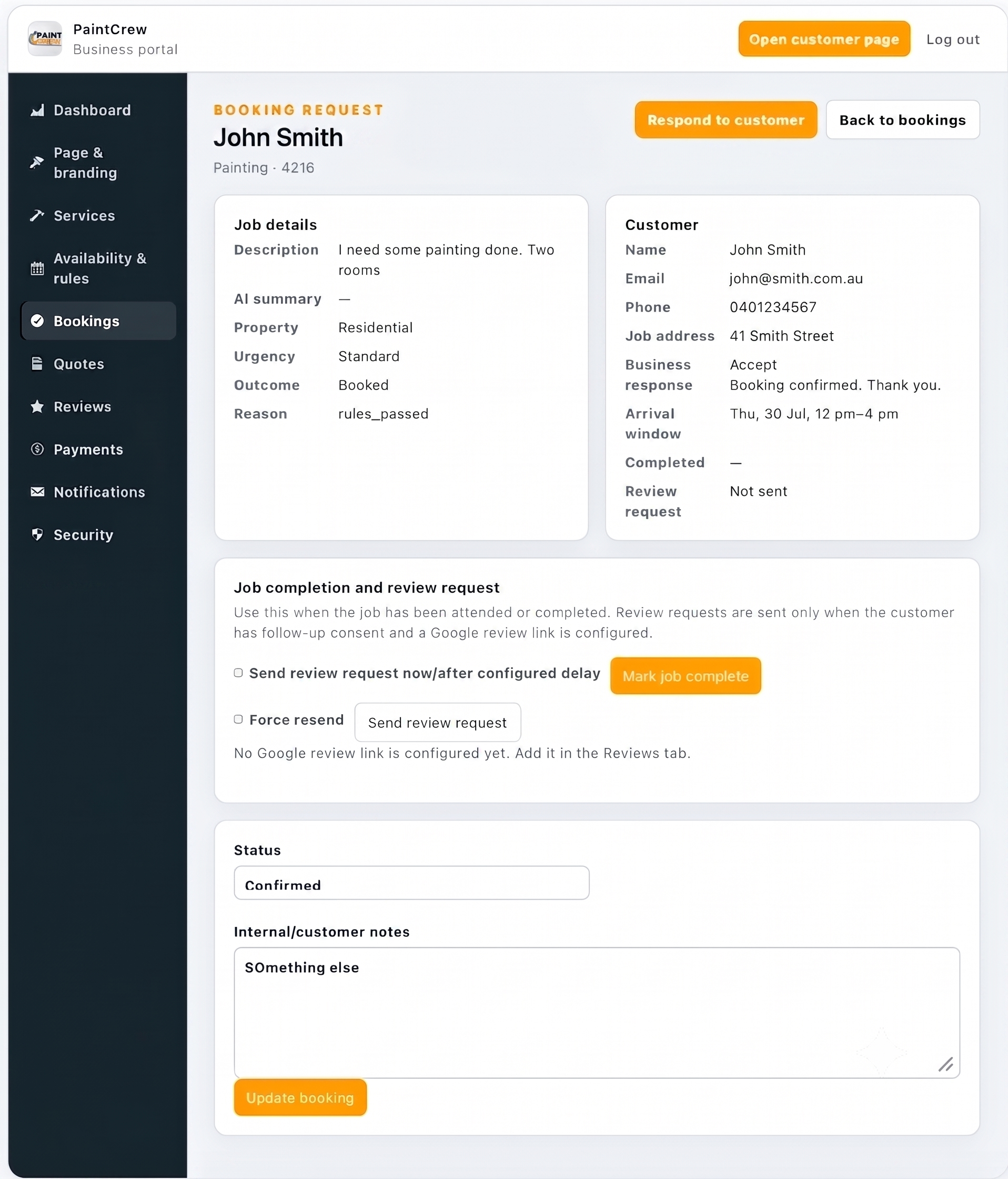
Qualified customer request
The business receives the customer, service, location and job information together.
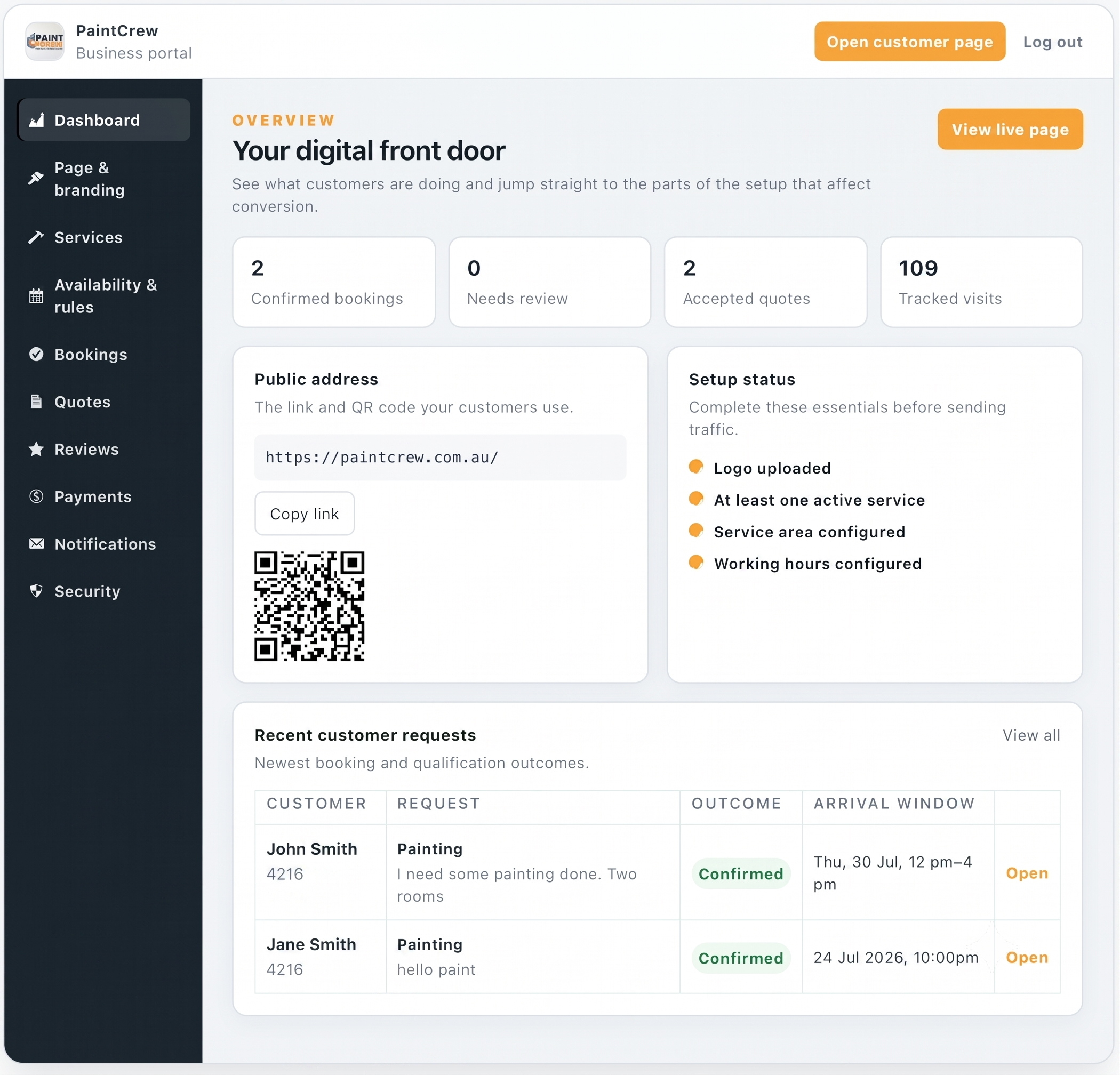
Business portal
The business sees direct customer requests, bookings, quotes and public Front Door activity.
Try the direct customer journey.
Open PaintCrew inside this article or visit the demonstration in a separate browser tab.
PaintCrew is a BrandUte demonstration using sample customer and transaction information.
Shared lead and owned enquiry questions
Are shared leads always bad for tradies?
No. A shared lead platform can provide access to customers who are actively looking for help. It may be particularly useful for a new business, a quiet schedule or a tradie with a strong conversion process. The commercial question is whether the jobs won justify the money and time spent.
Are owned enquiries free?
No. Direct enquiries may require investment in advertising, websites, domains, customer reviews, content, search visibility, signage, systems and business reputation. The difference is that these investments can support a direct acquisition channel under the business’s own identity.
Does an owned enquiry mean the customer is guaranteed to choose me?
No. A direct customer may still be contacting or comparing other providers. The business still needs to respond, establish trust, price appropriately and deliver a suitable service.
Which type of enquiry converts better?
It varies by business, trade, location and source. A marketplace lead may have strong immediate intent. A referred or direct customer may have stronger trust in the individual business. Track conversion rate, job value, gross margin and time spent for each channel.
Should I stop using lead marketplaces?
Not merely because they are marketplaces. Keep a channel when it produces profitable work at an acceptable cost. At the same time, build direct channels so the business is not completely dependent on one external source.
How do I calculate the real cost of a lead?
Add the direct platform or marketing cost to the value of time spent responding, qualifying, travelling and quoting. Divide that amount by the number of jobs actually won to estimate acquisition cost per won job.
Does BrandUte generate leads?
BrandUte does not provide a shared marketplace audience or guarantee lead volume. It gives existing Google, referral, advertising, social, website, signage and QR traffic a branded customer journey through which to enquire, request a quote or book.
Does BrandUte send my enquiry to other tradies?
No. A customer using an individual business’s BrandUte Front Door is entering that business’s configured customer journey. BrandUte does not sell the same direct request to competing providers.
What is the best first owned channel for a tradie?
For many local service businesses, the foundation is a clear Google Business Profile, strong reviews, a memorable business destination and a customer journey that collects useful information. The right mix still depends on the trade and how customers currently find the business.
Can I use shared leads and BrandUte together?
Yes. Shared marketplaces can provide additional opportunities while BrandUte handles direct traffic under the business’s own domain. Measure each source separately so the business understands which channels produce worthwhile jobs.
Continue exploring customer-acquisition options.
BrandUte vs hipages
Compare a specific Australian marketplace model with BrandUte’s direct customer Front Door.
Read the comparison →Tradie website vs booking Front Door
Understand the difference between explaining the business and guiding the customer towards action.
Read the guide →BrandUte vs ServiceM8
Compare a managed public acquisition journey with a complete job-management and field-service platform.
Read the comparison →Shared leads and owned enquiries solve different business problems.
Use shared leads when the immediate priority is gaining access to additional customers who are already requesting work.
Build owned enquiry channels when the priority is strengthening the business name, direct customer relationships, referrals, recognition and control over the customer journey.
Use both when marketplace opportunities are profitable but the business also wants a customer-acquisition foundation that does not depend entirely on one external provider.
The sensible decision is not based on declaring one channel morally superior. It is based on cost per won job, profit, capacity, job quality and the type of business being built.
Shared leads can help you win the next job. Owned enquiries can help the next customer look for you by name.